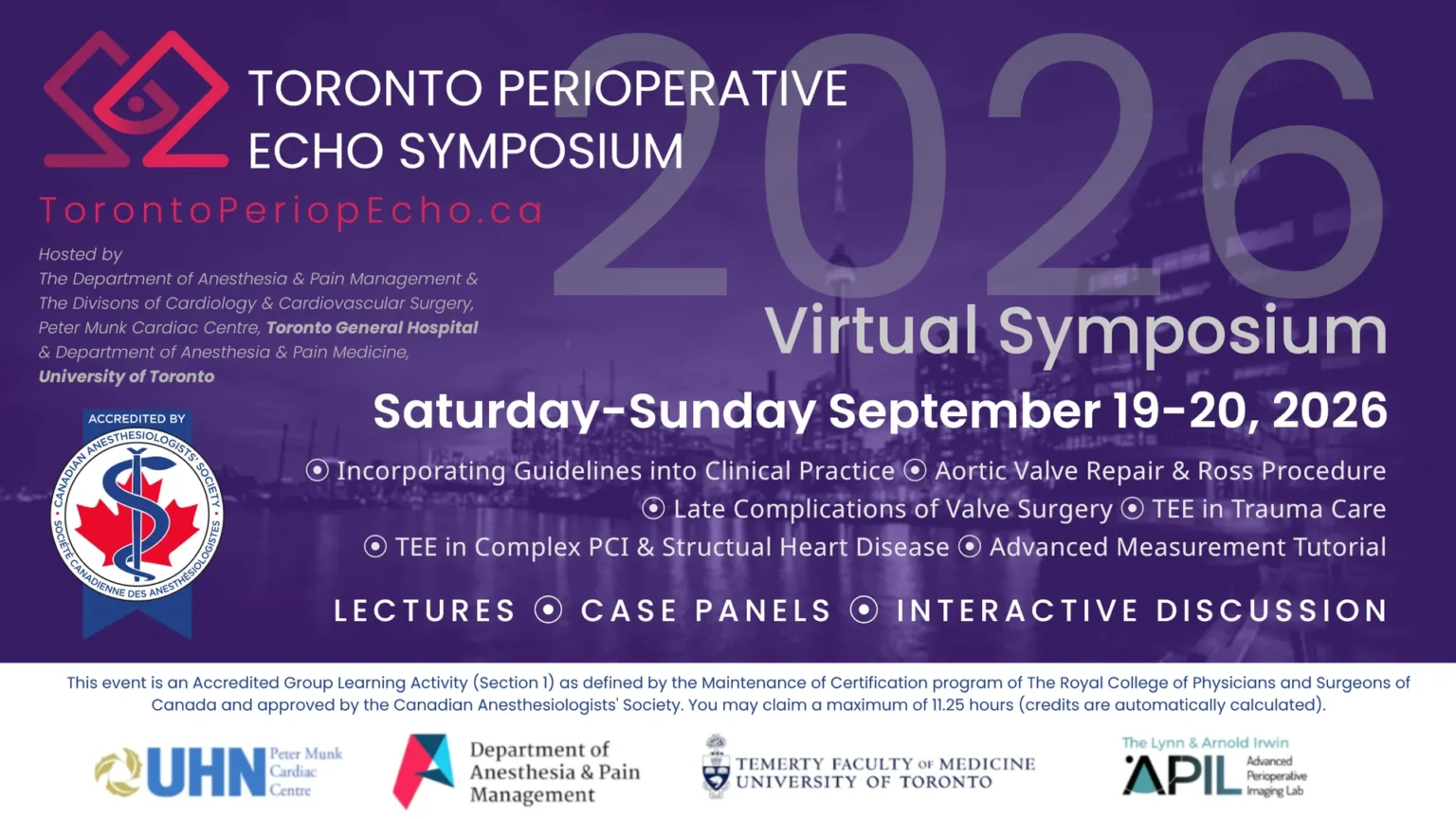
Virtual Symposium | Saturday & Sunday | September 19-20, 2026
REGISTRATION OPEN
REGISTRATION FEES
Early-bird rates until August 3, 2026, 11:59pm EST
Physicians*: $450 CAD (includes tax)
Fellows, Residents, Emeritus, Retired: $125 CAD (includes tax)
Standard rates starting August 4, 2026
Physicians*: $550 CAD (includes tax)
Fellows, Residents, Emeritus, Retired: $150 CAD (includes tax)
Main Topics:
Incorporating Guidelines into Clinical Practice
Aortic Valve Repair and Ross Procedure
Late Complications of Valve Surgery
TEE in Trauma Care
TEE for Complex PCI and Structural Heart Disease
Advanced Measurement Tutorials
Overall Objectives:
Demographic shifts & technical developments in therapeutic interventions and imaging are contributing to a significant expansion of the use of POCUS and TEE. In this two-day virtual symposium, our international multi-disciplinary faculty will illustrate the application of POCUS & TEE to address critical decisions in patient management across a wide range of acute care settings.
Upon completion of this program, participants should be able to:
- Describe the expanding scope of perioperative echo, including the range of modalities and new areas of application
- Illustrate the application of TEE and POCUS to address critical point-of-care decisions in a variety of acute-care situations & settings
- Review recent updates on the current guidelines related to the application of perioperative echocardiography in different clinical settings
- Critically discuss factors limiting translation of echocardiography into improved patient outcomes, and outline strategies for addressing these challenges
PROGRAM:
Day 1: Saturday, September 19, 2026
Session 1: Late Complications After Valve Repair
Curator: Dr. Massimiliano Meineri, Co-Chair Department of Anesthesia, Herzzentrum Leipzig, Germany for the European Association of Cardiothoracic Anesthesiology and Intensive Care (EACTAIC).
Moderator: Dr. Marcin Wasowicz, Consultant Cardiothoracic Anesthesiologist, Toronto General Hospital, Toronto, Canada.
09:00 – 09:20 : Failed Mitral Valve Repair. Dr. Johan Bence, Consultant Cardiothoracic Anesthesiologist, Glenfield Hospital, University Hospitals of Leicester NHS Trust, England, UK.
By the end of the lecture, participants should be able to:
- Identify mechanisms of mitral valve repair failure using TEE.
- Quantify residual or recurrent mitral regurgitation.
- Differentiate early versus late repair failure patterns.
- Guide decision making for re-intervention or surgical revision.
09:20 – 09:40 : Failed TAVI (Late). Dr. Massimiliano Meineri, Co-Chair Department of Anesthesia, Herzzentrum Leipzig, Germany for the European Association of Cardiothoracic Anesthesiology and Intensive Care (EACTAIC).
By the end of the lecture, participants should be able to:
- Recognize late complications following TAVI, including structural valve degeneration.
- Perform comprehensive echocardiographic assessment of failed TAVI.
- Differentiate causes of prosthetic dysfunction.
- Integrate imaging findings into re-intervention strategies.
09:40 – 10:00 : Complications for Transcatheter Interventions | Dr. Hany Elgamal, Consultant Cardiac Anesthesiologist, Herzzentrum Leipzig GmbH
By the end of the lecture, participants should be able to:
- Identify mechanisms of failure in transcatheter mitral interventions.
- Assess residual regurgitation and device-related complications using TEE.
- Evaluate patient suitability for repeat intervention or surgery.
- Formulate management strategies for complex post-intervention cases.
10:00 – 10:20 : Failed Aortic Valve Repair. Dr. Valentina Ajello, Echocardiographer, Cardiac Anesthesiologist, Tor Vergata University, Rome, Italy
By the end of the lecture, participants should be able to:
- Diagnose mechanisms of failed aortic valve repair using echocardiography.
- Quantify recurrent aortic regurgitation.
- Identify technical and anatomical contributors to repair failure.
- Guide re-intervention planning using imaging findings.
10:20 – 10:40 : Paravalvular Leaks. Prof. Justiaan Swanevelder. Previous UCT Head of Department of Anaesthesia and Perioperative Medicine and Emeritus Professor. Presently Consultant Anaesthetist at University Hospitals of Leicester NHS Trust, Leicester, UK.
By the end of the lecture, participants should be able to:
- Detect and quantify paravalvular leaks using advanced echocardiographic techniques.
- Differentiate clinically significant from incidental leaks.
- Guide percutaneous or surgical closure strategies using imaging.
- Recognize complications associated with paravalvular leaks.
1040 – 1110 : Session Q+A
- Panel discussion where all speakers join to answer questions from the audience, facilitated by a moderator.
11:10 – 11:30 : Break
Session 2: Advanced Procedures in the Cath Lab
Curators: Dr. Marcus Salvatori, Director of Perioperative Echocardiography, Toronto General Hospital, Toronto, Canada.
Moderator: Dr. Azad Mashari, Consultant Cardiothoracic Anesthesiologist, Toronto General Hospital, Toronto, Canada.
11:30 – 12:10 : Echocardiography in Advanced Cath-Based Procedures. Dr. Eric Horlick, Consultant Interventional Cardiologist, Toronto General Hospital, Toronto, Canada. Dr. Wendy Tsang, Consultant Cardiologist, Toronto General Hospital, Toronto, Canada.
By the end of the lecture, participants should be able to:
- Identify indications for structural and congenital transcatheter interventions.
- Acquire and optimize TEE views required for procedural guidance.
- Integrate echocardiography into real-time procedural decision making.
- Evaluate procedural success and complications using imaging.
12:10 – 12:50 : Management and Imaging in CHIP-PCI. Dr. Sanjog Kalra, Consultant Cardiologist, Toronto General Hospital, Toronto, Canada. Dr. Marcus Salvatori, Consultant Anesthesiologist, Toronto General Hospital, Toronto, Canada.
By the end of the lecture, participants should be able to:
- Describe the role of echocardiography in high-risk PCI.
- Assess myocardial function and perfusion in real time.
- Identify complications during complex coronary interventions.
- Integrate imaging findings into hemodynamic and procedural management.
12:50 – 13:20 : Session Q+A
- Panel discussion where all speakers join to answer questions from the audience, facilitated by a moderator.
13:20 – 13:30 : TPES Award
13:30 – 14:30 : Lunch
Session 3: Tutorial Session, Advanced 3D Measurements
Curator: Dr. Aidan Sharkey, Consultant Cardiothoracic Anesthesiologist, Beth Israel Deaconess Medical Centre, Boston, USA.
Moderator: Dr. Marcus Salvatori, Consultant Cardiothoracic Anesthesiologist, Toronto General Hospital, Toronto, Canada.
14:20 – 14:40 : How I Optimize 3D Image Acquisition (practical tips and troubleshooting), Dr. Feroze Mahmood, Consultant Cardiothoracic Anesthesiologist, Beth Israel Deaconess Medical Center, Boston USA.
By the end of the session, participants should be able to:
- Apply a systematic approach to optimizing 3D TEE image acquisition, including probe positioning, gain, depth, and sector width.
- Select appropriate acquisition modes (zoom, full-volume, multi-beat) based on the clinical question and patient conditions.
- Recognize and troubleshoot common artifacts, including stitch artifacts, dropout, and shadowing.
- Optimize temporal and spatial resolution while balancing image quality and acquisition time.
- Integrate high-quality 3D datasets into real-time clinical decision making and procedural guidance.
14:40 – 15:00 : How I Quantify the Aortic Valve Using 3D. Dr. Aidan Sharkey, Consultant Cardiothoracic Anesthesiologist, Beth Israel Deaconess Medical Centre, Boston, USA.
By the end of the session, participants should be able to:
- Perform multi-planar reconstruction (MPR) of the aortic valve.
- Accurately measure aortic valve area and morphology using 3D datasets.
- Recognize common pitfalls in MPR analysis.
- Apply MPR findings to clinical decision making.
15:00 – 15:20 : How I Quantify the Mitral Valve Using 3D. Dr. Mark Robitaille, Consultant Cardiothoracic Anesthesiologist, Beth Israel Deaconess Medical Centre, Boston, USA.
By the end of the session, participants should be able to:
- Perform MPR analysis of mitral valve regurgitation.
- Quantify vena contracta area and effective orifice area (EOA).
- Recognize limitations of 2D versus 3D quantification methods.
- Apply measurements to grading severity of mitral regurgitation.
15:20 – 15:40 : How I Quantify the RV and Tricuspid Valve Using 3D. Dr. Vahid Kiarad, Consultant Cardiothoracic Anesthesiologist, Beth Israel Deaconess Medical Centre, Boston, USA.
By the end of the session, participants should be able to:
- Acquire and optimize 3D datasets of the RV and tricuspid valve.
- Quantify RV volumes and function using 3D echocardiography.
- Measure tricuspid valve anatomy and regurgitation severity using 3D techniques.
- Integrate 3D findings into clinical and procedural decision making.
15:40 – 16:10 : Session Q+A
- Panel discussion where all speakers join to answer questions from the audience, facilitated by a moderator.
16:10 : Wrap Up and Adjournment
Day 2: Sunday, September 20, 2026
Session 4: Applying Guideline Recommendations in Daily Practice
Curators: Dr. Wendy Tsang, Consultant Cardiologist, Toronto General Hospital, Toronto, Canada.
Moderator: Dr. Annette Vegas, Consultant Cardiothoracic Anesthesiologist, Toronto General Hospital, Toronto, Canada.
09:00 – 09:20 : European Valvular Guidelines, Dr. Mateo Marin-Cuartas, Consultant Caridac Surgeon, Heart Center of Leipzig, Leipzig, Germany.
By the end of the lecture, participants should be able to:
- Interpret contemporary European valvular heart disease guidelines and their perioperative implications.
- Integrate guideline recommendations with patient-specific clinical and imaging data.
- Identify areas of controversy or limited evidence within current guideline frameworks.
- Apply guideline-based decision making to complex perioperative scenarios.
09:20 – 09:40 : Right Ventricle and Pulmonary Hypertension Guidelines, Dr. Monica Mukherjee, Johns Hopkins Bayview Medical Cente, Baltimore, USA.
By the end of the lecture, participants should be able to:
- Describe guideline-based approaches to right ventricular assessment and dysfunction.
- Perform comprehensive echocardiographic evaluation of RV size, function, and hemodynamics.
- Integrate RV assessment into perioperative risk stratification and management.
- Apply guideline recommendations to complex clinical scenarios involving RV failure.
09:40 – 10:00 : Diastology in the OR, Dr. Jacob Labus, Cardiovascular Anesthesiologist, Department of Anesthesiology and Intensive Care Medicine, Cologne University, Cologne, Germany.
By the end of the lecture, participants should be able to:
- Interpret diastolic function parameters in the intraoperative setting.
- Recognize limitations and pitfalls of diastolic assessment under anesthesia and altered loading conditions.
- Apply diastolic function grading to guide intraoperative management decisions.
- Critically appraise the clinical relevance of diastology in perioperative outcomes.
10:00 – 10:30 : Session Q+A
- Panel discussion where all speakers join to answer questions from the audience, facilitated by a moderator.
10:30 – 10:50 : Break
Session 5: Complex Aortic Valve Repair and the Ross Procedure
Curators: Dr. Ahmad Omran, Consultant Cardiologist, Toronto General Hospital, Toronto, Canada.
Moderator: Dr. Marcus Salvatori, Consultant Cardiothoracic Anesthesiologist, Toronto General Hospital, Toronto, Canada.
10:50 – 11:30 : Ross Procedure. Dr. Ismail El-Hamamsy, Consultant Cardiac Surgeon, Mt. Sinai Hospital, New York, USA. Dr. Emma Li, Consultant Cardiac Anesthesiologist, Mt. Sinai Hospital, New York, USA.
By the end of the lecture, participants should be able to:
- Describe the surgical principles and indications for the Ross procedure.
- Identify patient and anatomical factors influencing procedural success.
- Integrate TEE findings into intraoperative decision making for the Ross procedure.
- Evaluate postoperative outcomes and complications using echocardiography.
11:30 – 12:10 : Aortic Valve and Bicuspid Repair. Dr. Michael Borger, Cardiothoracic Surgeon, Chair of Cardiac Surgery, University of Leipzig, Germany, Dr. Massimiliano Meineri, Anesthesiologist, Leipzig Heart Center, Department of Anesthesiology, Germany.
By the end of the lecture, participants should be able to:
- Classify bicuspid aortic valve phenotypes and their surgical implications.
- Perform comprehensive TEE assessment of aortic valve and root pathology.
- Identify predictors of successful valve repair using multimodal imaging.
- Incorporate imaging findings into surgical planning and intraoperative decision making.
12:10 – 12:50 : Session Q+A
- Panel discussion where all speakers join to answer questions from the audience, facilitated by a moderator.
12:50 – 14:00 : Lunch
Session 6: TEE in Trauma
Curators: Dr. Pablo Perez d’Empaire, Consultant Anesthesiologist, Sunnybrook Health Sciences Centre, Toronto, Canada.
Moderator: Dr. Michael Szpejda, Consultant Anesthesiologist, Sunnybrook Health Sciences Centre, Toronto, Canada.
14:00 – 14:20 : Role of TEE in Challenging Trauma Cases, Dr. Jacobo Moreno, Consultant Anesthesiologist, Sunnybrook Health Sciences Centre, Toronto, Canada.
By the end of the lecture, participants should be able to:
- Identify indications for TEE in complex trauma scenarios.
- Recognize key echocardiographic findings in traumatic cardiac and hemodynamic compromise.
- Integrate TEE into rapid diagnostic and therapeutic decision making.
- Critically appraise cases where TEE altered clinical management.
14:20 – 14:40 : Resuscitative TEE in Critically Injured Patients, Dr. Ross Prager, Consultant Intensivist, London Health Sciences Centre, London, Canada.
By the end of the lecture, participants should be able to:
- Describe the principles and protocols of resuscitative TEE.
- Acquire and interpret focused TEE views in unstable trauma patients.
- Differentiate causes of shock using TEE in real time.
- Incorporate TEE into advanced resuscitation algorithms.
14:40 – 15:00 : ResusTEE Collaborative Network Experience, Dr. Felipe Teran, Assistant Professor of Emergency Medicine, Emergency Medicine , Weill Cornell Medical College, New York, USA.
By the end of the lecture, participants should be able to:
- Summarize the development and impact of the ResusTEE collaborative network.
- Evaluate the role of collaborative research in advancing resuscitative TEE practice.
- Interpret key findings from multicenter ResusTEE data.
- Identify opportunities for implementation and future research.
15:00 – 15:20 : Moving Perioperative TEE Outside of the Cardiac OR, Dr. Pablo Perez d’Empaire, Consultant Anesthesiologist, Sunnybrook Health Sciences Centre, Toronto, Canada.
By the end of the lecture, participants should be able to:
- Describe expanding indications for TEE in non-cardiac settings.
- Identify logistical, training, and safety considerations for TEE deployment outside the OR.
- Apply TEE to guide management in ICU, emergency, and trauma environments.
- Evaluate barriers and strategies for program implementation.
15:20 – 15:50 : Session Q+A
- Panel discussion where all speakers join to answer questions from the audience, facilitated by a moderator.
15:50 – 16:00 : Wrap Up and Adjournment